|
|
Beach Rip Current Safety |
| May 27, 2022 | |
This weekend is the "unofficial" start of summer. Many people will be heading to beaches this summer for their vacation. In fact, people from throughout the USA and visitors from throughout the world visit surf beaches. A “surf beach” is considered any beach with breaking waves. Anyone who visits a surf beach, whether at the ocean or large bodies of water like the Great Lakes, is exposed to the danger of rip currents. They are the #1 hazard at a surf beach, leading to tens of thousands of rescues by lifeguards and over 100 drowning fatalities every year in the United States.
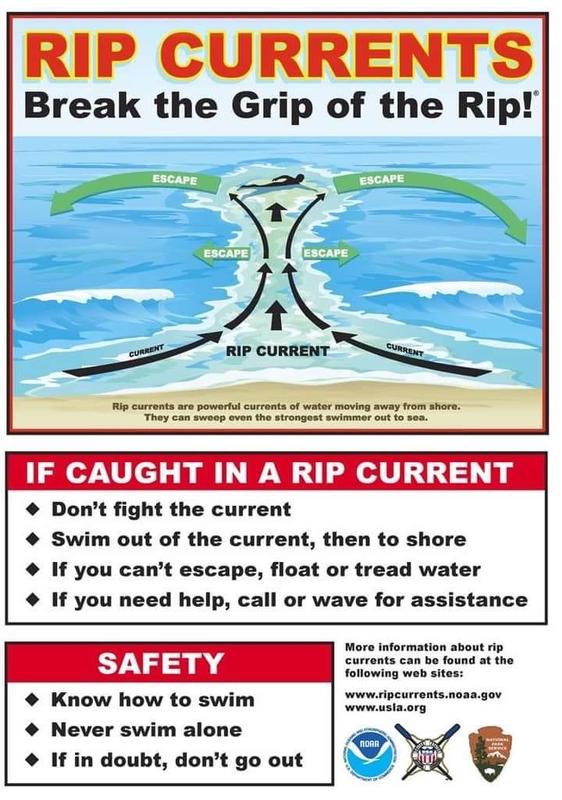
◆ Rip currents are channelized currents of water flowing away from shore at surf beaches. ◆ Rip currents typically form at breaks in sandbars, and also near structures such as jetties and piers. ◆ Rip currents are commonly found on all surf beaches, including Great Lakes beaches. ◆ Rip currents pull people away from shore. ◆ Rip current speeds can vary from moment to moment and can quickly increase to become dangerous to anyone entering the surf. ◆ Rip currents can sweep even the strongest swimmer away from shore. ◆ A scientific review of data provided to the United States Lifesaving Association found that there are over 100 deaths each year in the U.S. attributed to rip currents. ◆ Rip currents account for over 80% of rescues performed by surf beach lifeguards. ◆ A narrow gap of darker, seemingly calmer water between areas of breaking waves and whitewater. ◆ A channel of churning, choppy water. ◆ A difference in water color. ◆ A line of foam, seaweed or debris moving seaward. How can I protect myself and my family from rip currents? ◆ Always swim in an area protected by lifeguards ◆ Consult lifeguards before entering the water. ◆ Assume that rip currents are always present at surf beaches. ◆ Learn to swim in the surf and make sure your children can swim in the surf. Pool swimming is not the same as swimming at a surf beach. ◆ Learn to identify rip currents and take the time to evaluate the water before you enter the water.
◆ Relax, rip currents don't pull you under. ◆ Don’t swim against the current. ◆ You may be able to escape by swimming out of the current in a direction following the shoreline, or toward breaking waves, then at an angle toward the beach. ◆ You may be able to escape by floating or treading water if the current circulates back toward shore. ◆ If you feel you will be unable to reach shore, draw attention to yourself. If you need help, yell and wave for assistance. ◆ Don't become a victim while trying to help someone else! Many people have died trying to rescue rip current victims. ◆ Get help from a lifeguard. ◆ If a lifeguard is not present, call 9-1-1, then try to direct the victim to swim following the shoreline to escape. ◆ If possible, throw the rip current victim something that floats. ◆ Never enter the water without a flotation device. Facts about rip currents ◆ Rip currents do not pull people under the water—they pull people away from shore. ◆ Rip current speeds vary. Average speeds are 1-2 feet per second, but they have been measured as fast as 8 feet per second—faster than an Olympic swimmer! ◆ Rip currents can be very narrow or more than 50 yards wide. ◆ Sometimes a rip current ends just beyond the line of breaking waves; however, others may continue to flow hundreds of yards offshore. ◆ Rip currents are sometimes mistakenly called undertow or riptides but these terms are not correct. Only the term rip currents is technically correct.
◆ Know how to swim. ◆ Swim near a lifeguard. ◆ Never swim alone. ◆ If in doubt, don't go out. |
|
|
|